
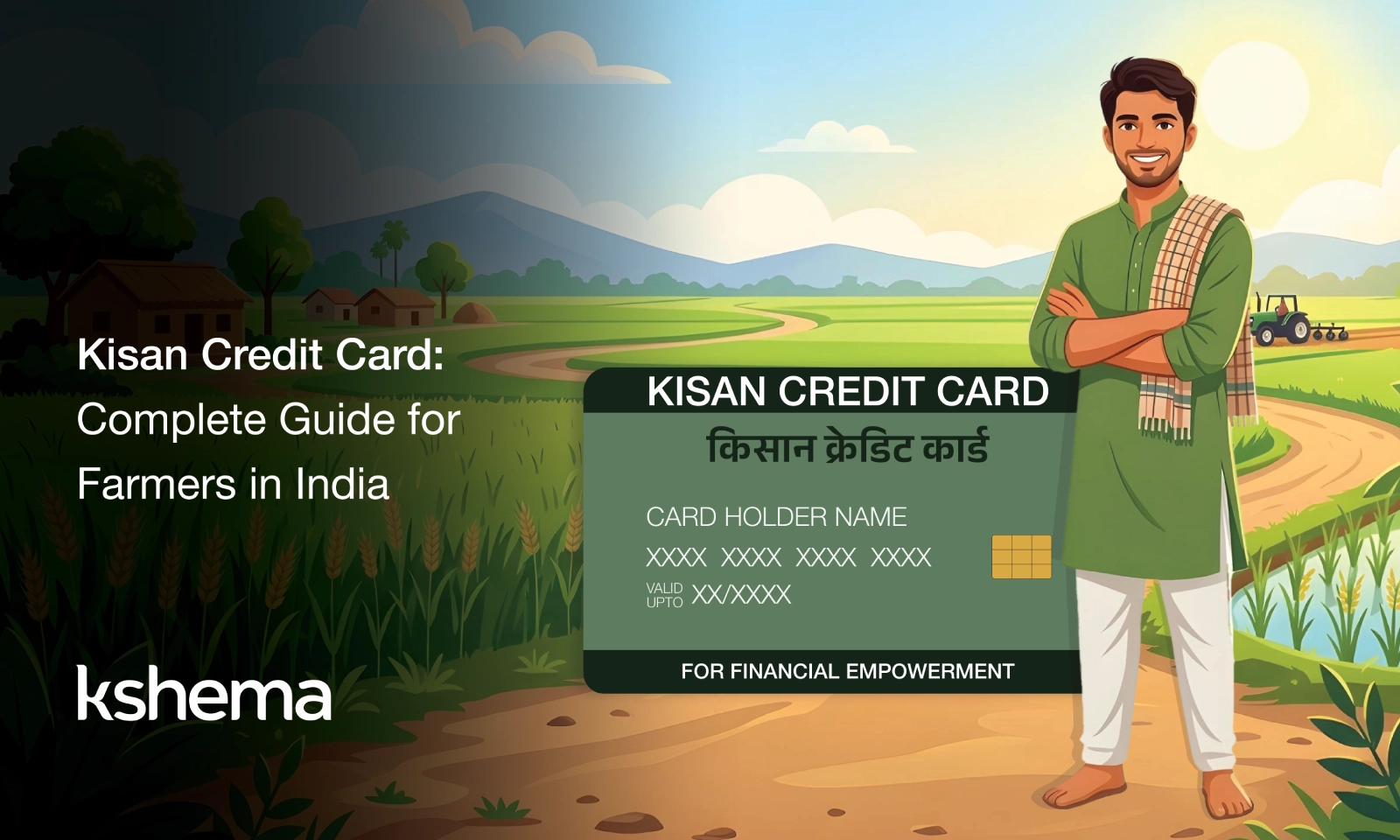
The Kisan Credit Card (KCC) is a Government of India initiative designed to provide farmers with easy access to credit for agricultural needs. It simplifies borrowing, extends financial inclusion, and ensures timely monetary support. The Ministry of Agriculture and Farmers Welfare operates this beneficial scheme.
- Buy in easy steps
- Premium Starts at INR 499
- Protect 100+ Crops
- Quick & Easy Claims

What this blog will cover:
- What the Kisan Credit Card is and how it works
- Key KCC benefits for farmers
- Details on the KCC interest rate and repayment terms
- Step-by-step process to apply for a Kisan Credit Card
Understanding the Kisan Credit Card
Farmers can use the card much like a debit card, withdrawing funds as needed within the sanctioned limit. This ensures that they have timely access to money during sowing, harvesting , and other critical stages of farming.
The scheme was further extended for the investment credit requirement of farmers viz. allied and non farm activities The scheme provides broad guidelines to banks for operationalising the KCC scheme. Implementing banks have the discretion to adopt the same to suit institution/location-specific requirements.
Objective of KCC scheme
The Kisan Credit Card scheme aims at providing adequate and timely credit support from the banking system under a single window with the flexible and simplified procedures to the farmers for their cultivation and other needs as indicated below:
- To meet the short-term credit requirements for the cultivation of crops
- Post‑harvest expenses
- Produce marketing loan
- Consumption requirements of farmer household
- Working capital for maintenance of farm assets and activities allied to agriculture
- Investment credit requirement for agriculture and allied activities
KCC interest rate explained
The KCC interest rate is one of the most attractive features of the scheme. According to the KCC circular dated 20 April 2012, the interest rate is 7% p.a. on short-term credit with a INR 3 lakh upper limit on the principal amount.
The Government of India provides interest subvention of 2% and Prompt Repayment Incentive of 3% to the farmers, thus making the credit available at a very subsidised rate of 4% per annum.
This makes the KCC interest rate far more affordable than borrowing from informal lending sources like moneylenders, who often charge exorbitant rates.
Eligibility criteria for Kisan Credit Card
To apply for a Kisan Credit Card, farmers must meet certain eligibility requirements:
- Farmers – individual/joint borrowers who are owner cultivators
- Tenant farmers, oral lessees & share croppers
- Self Help Groups (SHGs) or Joint Liability Groups (JLGs) of farmers including tenant farmers,sharecroppers etc
How to apply for a Kisan Credit Card
Online application process
- Visit the website of the bank you wish to apply for the kisan credit card scheme
- From the list of options, choose Kisan Credit Card
- On clicking the option of ‘Apply’, the website will redirect you to the application page
- Fill the form with the required details and click on ‘Submit’
- On doing so, an application reference number will be sent. If you are eligible, the bank will get back to you for the further process within 3-4 working days
A farmer can visit the branch of the bank offering KCC benefits, fill the application form, provide details and documents sought for the bank to verify eligibility. An applicant can seek the assistance of a bank representative to complete the application process.
The bank verifies the identity of the applicant, residence and land-related papers and eligibility under the scheme. Once the bank is satisfied with its due diligence it approves the application and the card is
issued with a credit limit.
Documents required for Kisan Credit Card
- Application Form
- Two Passport Size Photographs
- ID proof (Driving License/Aadhar Card/Voter Identity Card/Passport
- Address Proof such as Driving License, Aadhar Card
- Proof of landholding duly certified by the revenue authorities
- Cropping pattern (crops grown) with acreage
- Security documents for loan limit above INR 1.60 lakhs/INR 3.00 lakhs, as applicable
- Any other document as per sanction
Key features of the Kisan Credit Card
The KCC benefits are many for the farmers. It provides them with financial security as they go about cultivating their land.
- Credit Limit: Based on crop type, landholding, and scale of finance.
- Validity: Usually valid for 3–5 years, subject to annual review.
- Insurance: Many cards include personal accident insurance.
- Usage: Funds can be used for seeds, fertilisers, pesticides, and equipment.
The Kisan Credit Card thus acts as a comprehensive financial tool for farmers.
Why farmers should Choose KCC
The Kisan Credit Card is more than just a loan facility; it is a lifeline for farmers. KCC interest rate is low, the scheme offers flexible repayment, and KCC benefits are instrumental in empowering farmers to invest in better seeds, modern equipment, and improved farming practices.
By reducing reliance on informal lenders, the scheme promotes financial inclusion and rural development.
Conclusion
The Kisan Credit Card is a transformative initiative for Indian agriculture. It provides farmers with affordable credit, insurance protection, and financial flexibility. With its attractive KCC interest rate and wide-ranging KCC benefits, it remains one of the most impactful schemes for rural India.
Frequently Asked Questions (FAQ)
1. What is the validity period of the Kisan Credit Card?
2. What is the age requirement in order to apply for a Kisan Credit Card ?
3. What is the interest rate applicable on the KCC ?
4. What are the type of facilities available for finance under the scheme
5. What are the Security norms for financing under Kisan credit card
6. What are benefits provided by Govt of India to improve finance under KCC
The interest subvention @2% and prompt repayment incentive benefit @3% on KCC
loan (i.e. crop loan + working capital loan for animal husbandry and fisheries) will be available on an overall limit of INR 3 lakh per annum and subject to a maximum limit of INR 2 lakh per farmer involved in activities only related to animal husbandry and/or fisheries.