

Top 10 Benefits of Crop Insurance for Farmers
Farming is exposed to multiple risks—from unpredictable weather and pest attacks to fluctuating market conditions. Crop Insurance for Farmers plays a crucial role in protecting agricultural income when such uncertainties lead to crop loss.
By offering financial support during natural calamities or yield loss, crop insurance helps farmers continue farming without falling into debt. This blog explains the top benefits of crop insurance for farmers and why it is an essential safety net for sustainable agriculture.
- Buy in easy steps
- Premium Starts at INR 499
- Protect 100+ Crops
- Quick & Easy Claims
Benefits of Crop Insurance for Farmers:
- Protects farmers against crop loss due to natural calamities
- Ensures financial stability during uncertain farming seasons
- Reduces dependence on loans and informal borrowing
- Encourages adoption of modern farming practices
- Supports long‑term agricultural sustainability
- Acts as income protection during yield loss
- Strengthens rural economic stability
What Is Crop Insurance for Farmers?
Crop Insurance for Farmers is a risk‑management solution that provides financial compensation when crops are damaged due to events such as droughts, floods, cyclones, pests, or diseases.
It helps farmers safeguard their income by covering losses that are beyond their control, ensuring that a single bad farming season does not disrupt their livelihood.
Importance of Crop Insurance for Farmers
The importance of crop insurance lies in its ability to protect farmers from unpredictable agricultural risks. Since farming income depends heavily on weather and natural conditions, crop insurance acts as a financial shield during crop failure or reduced yields.
Main problems it solves
- Weather and climate shocks (drought, flood, hail, unseasonal rains).
- Pest and disease outbreaks.
- Post-harvest losses due to extreme events.
- Credit default risk when crops fail.
Top 10 Benefits of Crop Insurance for Farmers
This blog explores the top 10 benefits of crop insurance for farmers. Highlighting how it mitigates agricultural risks and provides financial stability.
Financial Protection Against Crop Loss
Crop insurance provides compensation when crops are damaged due to natural disasters, helping farmers recover financially without exhausting their savings
2. Income Stability for Farmers
By reducing the financial impact of crop failure, crop insurance ensures stable income even during difficult agricultural seasons.
3. Reduces Dependency on Loans
One of the major advantages of crop insurance is that it minimizes farmers’ reliance on high‑interest loans during crop loss, reducing long‑term debt.
4. Encourages Modern Farming Practices
With insurance coverage in place, farmers feel more confident investing in quality seeds, fertilizers, and improved farming techniques.
5. Protection Against Climate Uncertainty
Climate‑related risks such as droughts and unseasonal rainfall are increasing. Crop insurance helps farmers manage these uncertainties.
6. Supports Agricultural Sustainability
Crop insurance enables farmers to continue cultivation even after losses, supporting long‑term agricultural productivity.
7. Improves Access to Institutional Credit
Insured farmers are often seen as lower‑risk borrowers, improving access to formal agricultural loans.
8. Reduces Financial Stress
Knowing that crop loss is covered financially reduces stress for farmers and their families.
9. Strengthens Rural Economy
By stabilizing farmer income, crop insurance contributes to the stability of rural and allied agricultural activities.
10. Acts as a Safety Net During Natural Calamities
Crop insurance serves as a financial safety net during floods, droughts, or pest attacks, helping farmers recover and replant.
Types of crop insurance and which to choose
Crop insurance protects your farm income when nature or pests damage your crop. If a covered event like drought, flood, hail or a pest attack harms the field, you may receive a payout as per the policy. This money helps manage family needs, repay loans and buy seeds, fertiliser and labour for the next sowing.
With changing weather and rising input costs, one bad season can cause heavy loss. Insurance reduces that shock so your plans continue. Think of it as a guard for your cash flow, not just a formality.
Different types of crop insurance suit different needs, crops and risk profiles. Understanding the main options helps farmers and agri‑businesses choose the right protection.
Crop Insurance Benefits for Farmers at a Glance
| Benefit Area | How It Helps Farmers |
| Financial Security | Provides compensation for crop loss and reduces income shock |
| Risk Management | Protects farmers against weather uncertainties and natural calamities |
| Credit Access | Improves eligibility for institutional and agricultural loans |
| Mental Well‑being | Reduces stress and financial anxiety during crop failure |
| Agricultural Sustainability | Encourages continued farming and long‑term productivity |
Weather‑indexed insurance
Triggers payouts based on objective weather parameters (rainfall, temperature). Faster claims and lower moral hazard; best where reliable weather stations or satellite data exist.
Revenue insurance
Protects against combined price and yield losses — useful where price volatility is high.
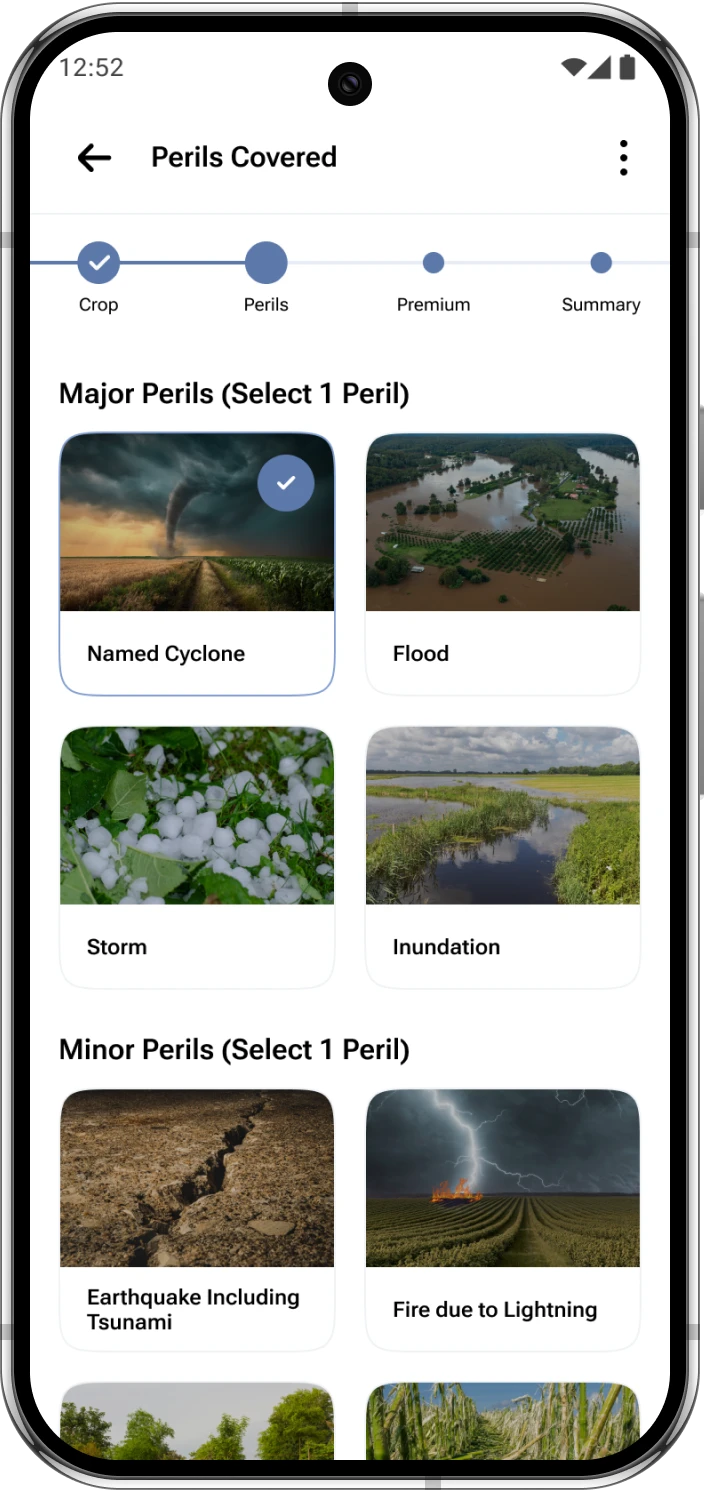
Named‑peril vs. multi‑peril
Named‑peril covers specific hazards (e.g., hail). Multi‑peril offers broader coverage but can be costlier.
How crop insurance improves access and advantages for farmers
Insurance increases “access” in three ways: access to credit, access to inputs (seed/fertiliser on credit), and access to markets through reduced risk. The advantages of a farmer using crop insurance include better bargaining power with buyers, smoother cashflow and reduced dependence on informal lenders.
Example scenarios
Smallholder with indexed insurance obtains a short-term loan to buy quality seed; harvests even if partial loss occurs and repays loan using claim payout.
Commercial farmer uses revenue cover to protect against both yield shortfall and price crash, securing contracts with processors.
Choosing the right crop insurance scheme (step-by-step)
Use these steps as a simple checklist when comparing different crop insurance schemes or products:
- Identify primary risks for your crop (drought, flooding, pests).
- Compare product types: index vs yield vs revenue.
- Check coverage limits, sum insured calculations, premium subsidies and exclusion clauses.
- Review claim process: documentation, survey timelines and pay-out triggers.
- Confirm network: approved surveyors, banks and digital claim channels.
- Estimate value-for-money: expected premium vs. probable payout under historical risk.
How to make crop insurance work for you (practical tips)
Follow these practical tips so your crop insurance for farmers policy gives you the maximum benefit:
- Keep good records (planting dates, inputs used, yields) to speed claims for yield policies.
- Opt for indexed products where local weather data is reliable for faster payouts.
- Bundle insurance with credit or input packages when possible to reduce upfront cost.
- Use risk reduction measures (drainage, pest monitoring) to lower likelihood of loss and sometimes premiums.
- Compare insurers and government schemes—subsidies often make schemes more affordable.
How Does Crop Insurance Reduce Overall Agricultural Risk?
Crop insurance plans, by diversifying financial risks, play a key role in reducing overall agricultural risk.
It allows farmers to share the burden of potential losses with insurance providers, easing the financial impact of adverse events. This collective approach to risk management financially strengthens the agricultural community and promotes long-term viability.
List: Quick checklist before buying crop insurance
- What are my top three risks? (e.g., drought, flood, pests)
- What type of policy matches these risks? (yield / index / revenue / named‑peril / multi‑peril)
- What is the sum insured per acre/hectare and does it match my investment?
- What documents will I need at claim time?
- How do I report loss—app, call centre, bank, local nodal officer?
- Are there any government subsidies or special schemes I can benefit from?
Does Crop Insurance Protect Farmers’ Income?
Crop insurance ensures a steady income for farmers, even in times of crop failure or market fluctuations. By providing compensation for lost or damaged crops, it helps maintain their income levels and supports their financial well-being. This income protection is crucial for small-scale farmers who depend on agricultural produce for their livelihood and the opportunity to improve their quality of life.
Read also: How Does Crop Insurance Work? Understanding the Basics and Benefits for Farmers
Most crop insurance programs are part of broader support initiatives designed to strengthen the agricultural sector’s resilience. These programs often include services such as technical assistance, training, and access to resources, helping farmers improve productivity and sustainability.
Crop insurance can therefore be an integral part of a larger system that combines various support mechanisms with a holistic approach to agricultural development.
What Are the Limitations of Crop Insurance and How Can They Be Addressed?
While crop insurance provides many benefits, it also has limitations such as delayed claim settlements, lack of awareness among farmers, and limited coverage in some regions. Addressing these challenges is essential to maximize the effectiveness of agricultural insurance.
Conclusion
Crop Insurance for Farmers is a crucial tool for managing agricultural risks and ensuring financial security. From protecting income during crop loss to supporting long‑term sustainability, the benefits of crop insurance extend beyond individual farmers to the entire rural economy.
By opting for crop insurance, farmers can safeguard their livelihoods, reduce uncertainty, and continue farming with greater confidence even during challenging conditions.
Key Takeaway:
Crop insurance is essential for protecting farmers’ livelihoods, ensuring income stability, and promoting agricultural growth. Kshema’s innovative products like Sukriti and Prakriti offer tailored solutions to meet farmers’ needs.
Frequently Asked Questions About Crop Insurance for Farmers
1. What are the main benefits of crop insurance for farmers?
The main benefits of crop insurance for farmers include financial protection, income stability, reduced dependency on loans, and protection against natural calamities
2. Why is crop insurance important in agriculture?
Crop insurance is important because agriculture depends heavily on weather conditions, making farmers vulnerable to crop loss.
3. How does crop insurance help farmers during crop failure?
Crop insurance provides compensation during crop failure, allowing farmers to recover and prepare for the next season.
4.Is crop insurance useful for small and marginal farmers?
Yes, crop insurance is especially beneficial for small and marginal farmers as it protects their limited income.
5. Does crop insurance encourage better farming practices?
Yes, with financial risks covered, farmers are more likely to adopt modern and improved farming techniques.