

Stay Updated with Our Latest Blogs
Subscribe to our blog and get the latest insurance tips, guides, and industry updates delivered to your inbox
Subscribe to our blog and get the latest insurance tips, guides, and industry updates delivered to your inbox
Crop Insurance
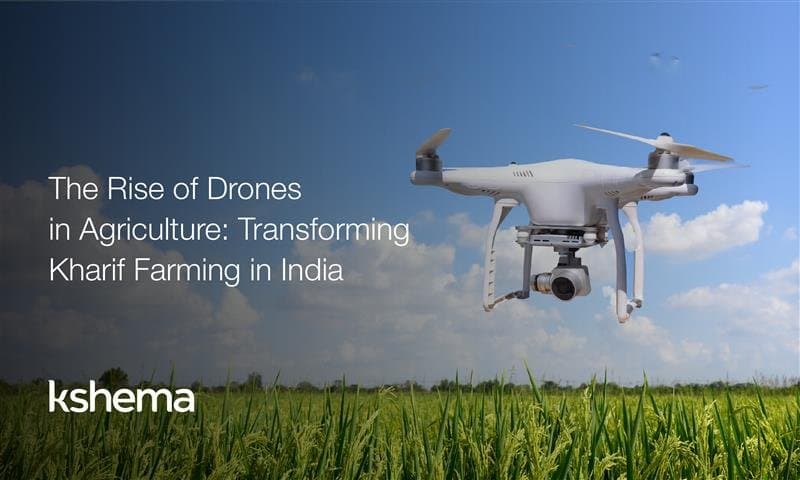
India’s agricultural landscape is undergoing a quiet revolution — driven by the integration of advanced technologies in traditional farming practices. As we enter the Kharif season (opens in a new tab), which is critical for crops such as paddy, maize, cotton and soyabean, one such innovation is gaining significant ground: the use of drones in agriculture.
From mapping farmlands to spraying pesticides, drones are helping farmers boost productivity, reduce input costs, and make faster, data-driven decisions. As a crop insurer, Kshema recognises the immense value drones bring not just to cultivation, but to risk assessment, claims processing (opens in a new tab), and long-term resilience building.
Agricultural drones, or UAVs (unmanned aerial vehicles), are specially designed to carry out tasks related to crop management. These drones are equipped with multispectral and thermal sensors, high-resolution cameras, and, in many cases, precision spraying equipment. With the ability to cover large swathes of farmland in a short time, they provide a bird’s-eye view of crop health and farm conditions — something that was unimaginable even a decade ago.
In India, particularly during the Kharif season when weather patterns are unpredictable (opens in a new tab) and pests are more active, these drones offer real-time solutions to age-old farming challenges.
India’s agricultural landscape is undergoing a quiet revolution — driven by the integration of advanced technologies in traditional farming practices (opens in a new tab). As we enter the Kharif season, which is critical for crops such as paddy, maize, cotton and soyabean, one such innovation is gaining significant ground: the use of drones in agriculture.
By using NDVI (Normalised Difference Vegetation Index) sensors, drones can assess crop vigour and identify problems well before they become visible to the naked eye. Early detection during the Kharif season allows for timely corrective actions, resulting in healthier yields and lower losses.
One of the major advantages of using drones in agriculture is precision. Fertilisers, pesticides and weedicides can be sprayed only where needed, in the right quantities, and with uniform coverage. This not only reduces wastage and environmental impact but also significantly saves cost for farmers.
Kharif crops (opens in a new tab) like cotton and paddy are particularly vulnerable to pests and fungal infections during monsoons. Drones can complete spraying operations even during short weather windows, ensuring that fields are protected without delay.
Drones are being used to generate detailed field maps, identify variations in soil types (opens in a new tab), and assess slopes, drainage, and moisture levels. This information can help them make better decisions about sowing patterns (opens in a new tab), seed varieties, and irrigation planning.
With rainfall being erratic in many parts of India during the Kharif season, data-driven land preparation becomes even more critical. Drones provide a cost-effective way to collect such data and tailor farming practices to local conditions.
As an insurer focused on protecting Indian farmers (opens in a new tab), Kshema sees technology as a partner in delivering timely and transparent services. Drones are playing a vital role in crop loss assessment after events like floods, hailstorms, or droughts — all of which are common risks during the Kharif period.
High-resolution drone images provide objective evidence of the extent and nature of damage, making it easier for insurance companies to process claims fairly and promptly. This not only strengthens farmer trust but also improves the credibility and sustainability of the insurance ecosystem.
The Government of India has recognised the transformative potential of drones in agriculture. Through government schemes (opens in a new tab) such as the Sub-Mission on Agricultural Mechanisation (SMAM), financial assistance is being provided to make drone services accessible to farmers and FPOs (Farmer Producer Organisations).
Several agri-tech start-ups have also entered the fray, offering drone-based services for spraying, mapping, and crop analytics. These services are now being bundled with advisory tools, insurance, and credit linkages — creating a holistic ecosystem for smarter farming.
While the momentum is encouraging, a few challenges still need to be addressed. These include the high initial cost of drones, lack of trained drone pilots in rural areas, and some regulatory complexities around drone operations and data sharing.
However, with increasing awareness, government push, and collaboration between insurers, start-ups and agri-extension services, these barriers are steadily being lowered. Training rural youth to operate drones not only bridges the skill gap but also opens employment opportunities.
As we look to the future, the use of drones in agriculture will only grow — becoming a cornerstone of precision farming and rural resilience. For Indian farmers, especially those dependent on Kharif crops (opens in a new tab) and the monsoon’s mercy, drones offer a way to reduce uncertainty and improve outcomes.
At Kshema (opens in a new tab), we believe in supporting such innovations that align with our mission — protecting the future of farmers.
Drones in agriculture are used for crop spraying, field mapping, soil analysis, and monitoring crop health, helping farmers save time and resources.
Agricultural drone services include spraying pesticides, monitoring crop growth, detecting pests, and providing real‑time data for precision farming.
Drone farming in India refers to the use of drones for sowing
“We do not assume any liability for any actions undertaken based on the information provided here. The information gathered from various sources and are displayed here for general guidance and does not constitute any professional advice or warranty of any kind.”


IntroductionIf you own a vehicle, understanding third-party car insurance is essential. It is the most basic form of motor insurance and is required by law for all vehicles driven on Indian roads.What This Blog Covers • What third-party insurance means and how it works. • Why it is considered mandatory car insurance in India. • The benefits, coverage, and limitations of this policy. • The consequences of ignoring the car insurance legal requirement.This guide provides a clear overview of the leg

Meri Fasal Mera Byora is a Haryana government initiative to benefit the farmers of the state. It is an important platform for crop registration and provides access to various government agriculture-related benefits. As the Kharif 2026 season is in progress, completing registration correctly can help farmers avoid delays in receiving support and scheme benefits by understanding benefits of insurance to farmers.What This Guide CoversWho should register for kharif 2026Documents and details required
IntroductionCrop Loss in Karnataka remains a critical challenge for farmers, especially during the kharif season when weather uncertainties are at their peak. Understanding the causes and taking preventive measures can significantly reduce risks and improve yields by understanding proven ways to protect crops.In this blog, you’ll learn:Major causes behind crop damage in KarnatakaKey Karnataka kharif crop risks farmers should watch out forPractical strategies to minimise losses and protect cropsP

IntroductionThe Rythu Bharosa scheme in Telangana continues to play a crucial role in supporting farmers during Kharif 2026. This is the Telangana government’s flagship farmer investment support scheme for seeds, fertilisers, and labour. By providing timely financial assistance, it helps reduce input costs and stabilise agricultural income and improve financial security through benefits of insurance to farmers.What this blog coversKey advantages of the scheme in Kharif 2026How Rythu Bharosa supp
IntroductionThis is our Maharashtra Kharif crops guide that can help the farmers of Maharashtra plan the upcoming monsoon season effectively. With the right crop choices, sowing time, and risk protection strategies, farmers can maximise yield and reduce uncertainty with the help of https://kshema.co/plans/What this blog covers:Best crops suited for the Kharif season in MaharashtraIdeal sowing dates to ensure higher productivityRegion-wise considerations for crop planningPractical insurance tips

If your PM Kisan payment has not been credited in 2026, it can be both confusing and frustrating. Many farmers across India face delays due to technical or verification issues, but most problems can be resolved with the right steps.In this blog, you will learn:Why your instalment may be delayed or missingHow to complete a quick PM Kisan status checkWays to fix errors and receive future paymentsWhere to seek help if the issue persistsUnderstanding the PM-Kisan Samman Nidhi Scheme in 2026The PM-Ki